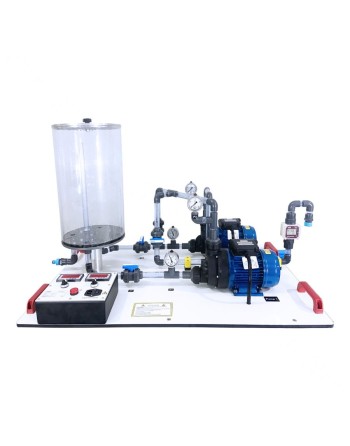
Reference : FM-100.09E
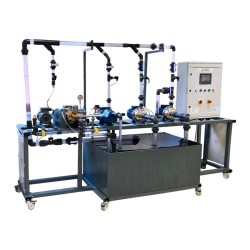
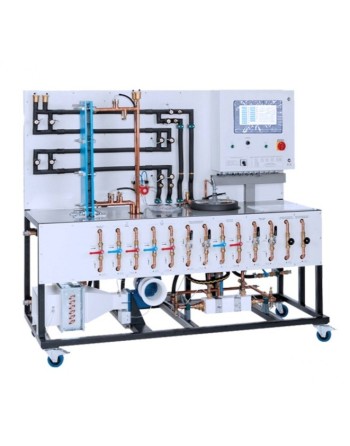
The FM-100.09E is a hydraulic training system designed for practical teaching in fluid mechanics and the study of pump performance. It enables students to investigate the operation of two pumps individually and in series and parallel configurations.
With its closed-loop hydraulic circuit, integrated instrumentation and control console, the system allows students to perform measurements, establish characteristic curves and experimentally analyse the main operating parameters of a pump.
Educational Applications
The FM-100.09E enables practical experiments covering:
- Determination of the relationship between flow rate and total head.
- Establishment of the pump head-flow characteristic curve.
- Determination of the specific speed of a pump.
- Determination of pump efficiency and analysis of the parameters affecting performance.
- Study of available NPSH (NPSH(A)) and the related concept of required NPSH.
- Study of two identical pumps operating in series.
- Study of two identical pumps operating in parallel.
- Experimental comparison of pump performance under different hydraulic configurations.
Experiments
Experiment 1 – Head-Flow Relationship
This experiment enables students to experimentally investigate the relationship between the total head and flow rate delivered by a pump. The measurements can be used to establish the pump’s head-flow characteristic curve and analyse its behaviour under different operating conditions.
Experiment 2 – Determination of Specific Speed
This experiment enables students to determine the specific speed of a pump experimentally. The resulting value can be used to characterize the type of impeller associated with the pump.
Experiment 3 – Pump Efficiency
Students can determine the pump efficiency from measured hydraulic and electrical parameters. The experiment also provides an opportunity to investigate the main factors affecting pump performance and efficiency.
Experiment 4 – NPSH Study
This experiment introduces the fundamental principles of NPSH (Net Positive Suction Head) and allows students to investigate the relationship between available NPSH (NPSH(A)) and required NPSH (NPSH(R)), as well as pump suction conditions.
Experiment 5 – Two Pumps in Series
Two identical pumps can be configured in series to experimentally investigate the effect of this arrangement on head and flow rate. Measurements can be used to determine and analyse the resulting characteristic curve.
Experiment 6 – Two Pumps in Parallel
Two identical pumps can also be configured in parallel. This experiment allows students to investigate the effect of the parallel configuration on flow rate and head and to experimentally determine the corresponding characteristic curve.