
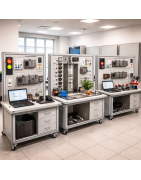
PLC

PLC

PLC

Active filters

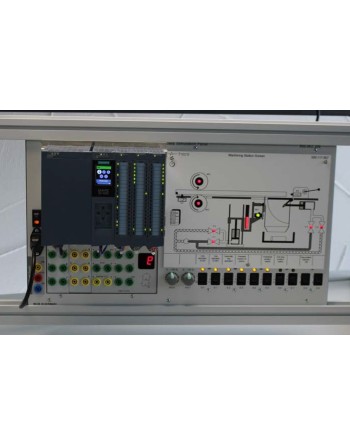
Process Simulation Panel for Simatic PLC


Hera_carre.jpg

References :

  • 950.062.200 Process Simulation Panel for PLC S7-1500
  • 950.032.800 Process Simulation Panel for PLC S7-1200


General Description

The PLC Process Simulation Panel provides a practical and efficient solution for simulating industrial processes without the need for PC-based software. Output signals are visualized directly through LEDs, running lights, a 7-segment display, and an acoustic buzzer.

This system is ideal for training, testing, and validating PLC programs in both educational and industrial environments.


Included Process Simulations

The panel includes multiple pre-configured process simulations:

  • Star-Delta Connection
  • Staircase Lighting
  • Intruder Alarm System
  • Traffic Lights (traffic-dependent and independent)
  • Conveyor Belt with Buffer Storage
  • Segment Gate Control
  • Machining Station
  • Bottling Plant
  • Mixing Vessel


Compatibility and Integration

The panel is equipped with a DIN rail for mounting Siemens PLCs, including:

  • Siemens S7-1200 (e.g., S7-1215C DC/DC/DC)
  • Siemens S7-1500 (e.g., S7-1512C-1PN)
  • ET200S for decentralized control

It can also be controlled using an external PLC via 4 mm input/output connectors.
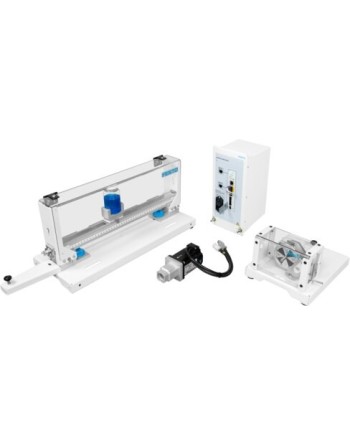


TP1421 - Servo Motor Control Technology


Festo Logo

Reference : 8200388 - Servo Motor Control Technology TP1421


The TP1421 training system provides a flexible, safe, and industry-oriented learning environment for servo motor and stepper motor control technology. This comprehensive solution enables learners to develop practical skills in installation, configuration, commissioning, maintenance, and troubleshooting of industrial drive systems.

The training package is based on the “Servo Motor Control” course, available either as a digital course through Festo LX or as a practical workbook. The learning activities combine theoretical knowledge with hands-on applications to strengthen the technical and operational skills of automation specialists, industrial electricians, maintenance technicians, and electrotechnicians.


Learning Objectives

Learners gain practical experience in the following areas:

  • Position, speed, and torque control
  • Operating principles of servo motors and stepper motors
  • Drive configuration and commissioning
  • Wiring and diagnostic techniques
  • Motor sizing methods
  • Homing procedures
  • Motion profile creation and optimization
  • PID control techniques
  • Power transmission methods
  • Troubleshooting and maintenance of drive systems
  • Multi-axis control using PLC systems


Key Benefits

  • Development of universal industrial skills
  • Compact and flexible training solution
  • Ready-to-use course materials for faster lesson preparation
  • Alignment with current industrial requirements
  • Practical learning activities based on real industrial applications
  • Efficient transfer of skills to the workplace


Training Topics

  • Open-loop and closed-loop control principles
  • Use of encoders and feedback systems for precise positioning
  • Drive commissioning and diagnostics
  • Parameter setting and troubleshooting techniques
  • Operation and applications of stepper motors and servo motors
  • Multi-axis coordination and PLC-based control
  • Creation of complex motion sequences
  • PID control implementation and tuning