Electrotechnics & Power Electronics

Electrotechnics & Power Electronics


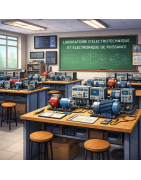
El Eslèk offers comprehensive solutions for practical teaching and training in power electronics and electrical engineering, designed for technical schools, universities, and professional training centers. Our laboratories enable students and professionals to understand, analyze, and master electrical power systems, applying theoretical concepts in safe, modular learning environments.


Our equipment covers a wide range of topics, including:

  • - Power converters and regulators (AC/DC, DC/AC, DC/DC)
  • - Electric motors and generators, including their control and protection
  • - Control and regulation circuits for electrotechnical systems
  • - Integration of power sensors and actuators
  • - Industrial applications related to energy, automation, and Industry 4.0


Developed in collaboration with experienced engineers and instructors, our solutions ensure precision, safety, and pedagogical effectiveness, providing progressive, modular learning that can be directly applied to real-world projects.


With modular design and interactive software tools, El Eslèk laboratories bridge theory and practice, helping learners understand the complex phenomena involved in modern power electronics and electrotechnical systems.


Electrotechnics & Power Electronics

Active filters

Training Module: Basics of Power Electronics


Hera_carre.jpg


Reference :

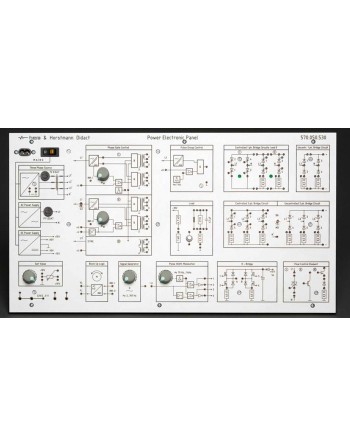
  • 570.050.530 – Power Electronics Panel


Overview

The Power Electronics Panel is a compact training system designed for performing experiments in power electronics on DC, single-phase AC, and three-phase AC circuits using a safe low-voltage approach.

The panel includes integrated resistive, inductive, and capacitive loads, enabling a comprehensive understanding of power electronics behavior and applications.

An optional motor/generator module can be added to extend the system capabilities to electromechanical and control system applications.


Single-phase AC Experiments

  • Uncontrolled half-wave rectifier
  • Uncontrolled bridge rectifier
  • Half-controlled bridge rectifier
  • Fully controlled bridge rectifier
  • Line-commutated rectifier
  • Pulse group control


Three-phase AC Experiments

  • Uncontrolled rectifier M3
  • Uncontrolled rectifier B6
  • Controlled rectifier M3
  • Controlled rectifier B6


DC Experiments

  • Basic PWM circuits
  • PWM with H-bridge (MOSFET)


GTO Experiments

  • Trigger pulse manipulation
  • GTO used as chopper


TP1421 - Servo Motor Control Technology


Festo Logo

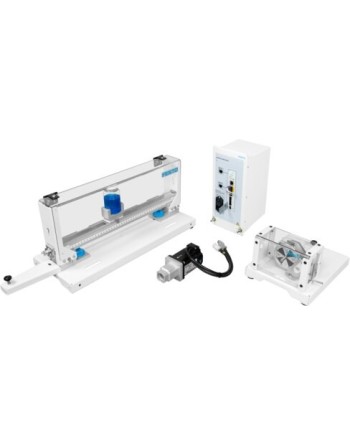
Reference : 8200388 - Servo Motor Control Technology TP1421


The TP1421 training system provides a flexible, safe, and industry-oriented learning environment for servo motor and stepper motor control technology. This comprehensive solution enables learners to develop practical skills in installation, configuration, commissioning, maintenance, and troubleshooting of industrial drive systems.

The training package is based on the “Servo Motor Control” course, available either as a digital course through Festo LX or as a practical workbook. The learning activities combine theoretical knowledge with hands-on applications to strengthen the technical and operational skills of automation specialists, industrial electricians, maintenance technicians, and electrotechnicians.


Learning Objectives

Learners gain practical experience in the following areas:

  • Position, speed, and torque control
  • Operating principles of servo motors and stepper motors
  • Drive configuration and commissioning
  • Wiring and diagnostic techniques
  • Motor sizing methods
  • Homing procedures
  • Motion profile creation and optimization
  • PID control techniques
  • Power transmission methods
  • Troubleshooting and maintenance of drive systems
  • Multi-axis control using PLC systems


Key Benefits

  • Development of universal industrial skills
  • Compact and flexible training solution
  • Ready-to-use course materials for faster lesson preparation
  • Alignment with current industrial requirements
  • Practical learning activities based on real industrial applications
  • Efficient transfer of skills to the workplace


Training Topics

  • Open-loop and closed-loop control principles
  • Use of encoders and feedback systems for precise positioning
  • Drive commissioning and diagnostics
  • Parameter setting and troubleshooting techniques
  • Operation and applications of stepper motors and servo motors
  • Multi-axis coordination and PLC-based control
  • Creation of complex motion sequences
  • PID control implementation and tuning