
Energy Eng.

Energy Eng.


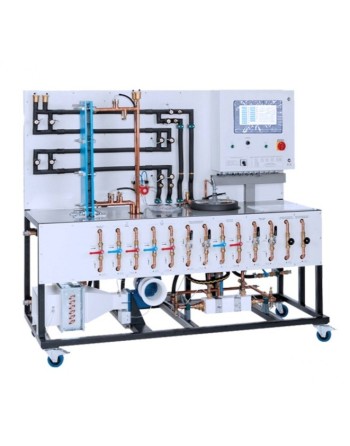
El Eslèk provides comprehensive solutions for energy engineering laboratories, designed for engineering schools, technical universities, training centers, and research departments. Our equipment is engineered to deliver advanced hands-on experiences, allowing students and professionals to understand, analyze, and optimize energy production, conversion, and management in safe and realistic environments.


Our offerings cover a wide range of energy engineering fields, including renewable energy, electricity generation and distribution, applied thermodynamics, heating and cooling systems, and industrial energy efficiency. These solutions enable learners to simulate, measure, and analyze energy systems, applying theoretical knowledge to real-world scenarios.


Developed in collaboration with energy engineers and specialized educators, our equipment ensures precision, reliability, and pedagogical effectiveness, fully aligned with academic curricula and the evolving needs of the energy sector.


Driven by a commitment to excellence, El Eslèk delivers high-quality energy engineering laboratory equipment at competitive conditions, while providing continuous innovation, expert technical support, and an optimal user experience, supporting both educational success and professional skill development.


Energy Eng.

Active filters

FCS3000 - Fuel Cell Simulation Software


Logo ITECH


Reference

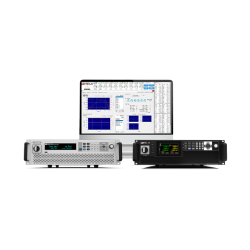
FCS3000 Fuel Cell Simulation Software


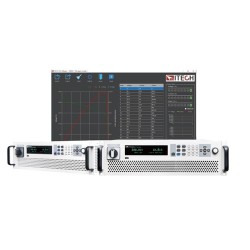
The FCS3000 Fuel Cell Simulation Software, when used in combination with the IT6000C bidirectional DC power supply and the IT6000B regenerative power system, enables accurate simulation of fuel cell stack polarization curves.

The system supports output voltages up to 2250 V and scalable power up to 1152 kW, meeting the requirements of high-power fuel cell simulation applications.

FCS3000 is specifically designed to replace real fuel cell stacks in laboratory environments, providing a highly efficient and flexible simulation platform for hydrogen energy and hybrid propulsion system research.

By eliminating the need for physical fuel cell stacks, the software helps reduce testing costs, simplify platform setup, and avoid performance degradation commonly associated with repeated experimental use of real fuel cell systems.

With its intuitive user interface and comprehensive data reporting capabilities, FCS3000 provides reliable experimental support for both practical testing and theoretical research.


Key Features

  • Automatic wide-range output with voltage up to 2250 V
  • Scalable fuel cell simulation power up to 1152 kW
  • User-defined fuel cell polarization curve with up to 4096 programmable points
  • Support for .csv file import for customized curve simulation
  • Data storage and export functions for analysis and reporting
  • Graphical software interface with real-time display of output voltage, current, and power


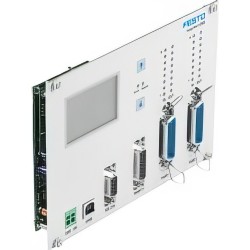
EasyPort Interface


Festo Logo

Reference : 548687


Technical Features

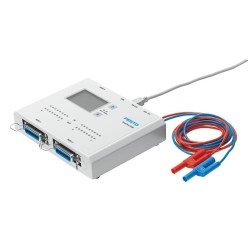
  • 16 digital inputs/outputs
  • 4 analog inputs and 2 analog outputs
  • 8 digital inputs/outputs each wired to a 24-pin SysLink connector (IEEE 488 compliant)
  • Digital input 0 on Port 1 and Port 2 configurable as high-speed counter input
  • Counter inputs operable with voltage levels from 5 to 24 V DC
  • Analog I/O connected via a 15-pin Sub-D connector
  • 12-bit analog-to-digital conversion resolution
  • Sampling rate: 0.5 kHz
  • Data communication via RS232 serial interface or USB
  • Transmission rate: 115.2 kbaud

Up to four EasyPort USB modules can be connected simultaneously via a USB hub or four separate USB ports on a PC. Each module must be assigned a unique address.

For signal exchange between EasyPort USB and PC software, the EzOPC OPC server or the EasyPort USB ActiveX control component is available.


EasyPort Interface, 19" version


Festo Logo

Reference : 8021637


Technical Features

  • 16 digital inputs/outputs
  • 4 analog inputs and 2 analog outputs
  • 8 digital inputs/outputs each wired to a 24-pin SysLink connector (IEEE 488 compliant)
  • Digital input 0 on Port 1 and Port 2 configurable as high-speed counter input
  • Counter inputs operable with voltage levels from 5 to 24 V DC
  • Analog I/O connected via a 15-pin Sub-D connector
  • 12-bit analog-to-digital conversion resolution
  • Sampling rate: 0.5 kHz
  • Data communication via RS232 serial interface or USB
  • Transmission rate: 115.2 kbaud

Up to four EasyPort USB modules can be connected simultaneously via a USB hub or four separate USB ports on a PC. Each module must be assigned a unique address.

For signal exchange between EasyPort USB and PC software, the EzOPC OPC server or the EasyPort USB ActiveX control component is available.


Fuel Cell Trainer


Logo Heliocentris

Reference : FCT-693


The Fuel Cell Trainer is a comprehensive educational system designed to teach the fundamental engineering principles of PEM fuel cell technology. With extensive experimental capabilities and thoroughly revised instructional materials, including predefined experiments, it provides a complete and structured learning solution.

All components of the fuel cell system are individually displayed, ensuring maximum transparency and clarity during instruction. Integrated parameter displays allow real-time monitoring of operating conditions, enhancing both theoretical understanding and practical insight.

Thanks to its modular design, the Fuel Cell Trainer can be easily adapted to different educational levels, from introductory courses to advanced engineering programs. The system is suitable for users with limited prior experience. The included software supports computer-assisted measurement, data acquisition, and experimentation, enabling precise analysis and documentation of results.

Key Features

  • Redesigned system architecture for enhanced engineering education
  • USB interface for simple plug-and-play installation
  • Improved instructional materials for both instructors and students
  • Advanced experimentation software with integrated data acquisition
  • Quick-start guides for fast setup and efficient operation

Learning Objectives

  • Understanding the structure and operating principles of PEM fuel cell systems
  • Application of thermodynamic fundamentals
  • Analysis of characteristic curves and efficiency performance
  • Fundamentals of system integration and power electronics

Areas of Application

Suitable for lectures and practical training in:

  • Electrical Engineering
  • Energy Engineering
  • Process Engineering
  • Mechanical Engineering
  • Automotive Engineering


SAS1000 - Solar Array Simulation Software


Logo ITECH


References

SAS1000 Solar array software for IT6500C/IT6000B/IT6000C/IT-M3600

SAS1000L Solar array software for IT6500C/IT6000B/IT6000C/IT-M3600 (power ≤15kW)

SAS1000M Solar array software for IT6500C/IT6000B/IT6000C/IT-M3600 (multi-channel)


ITECH introduces its latest high-speed, high-performance photovoltaic simulation solution. When combined with high-power DC power supplies, the SAS1000/L solar array simulation software accurately reproduces solar array I-V curves, with output voltage up to 2250 V and scalable system power up to 10 MW.

The system delivers fast dynamic response, excellent control accuracy, high repeatability, outstanding stability, and precision performance. It features built-in simulation models compliant with EN 50530, Sandia National Laboratories PV model, NB/T 32004, CGC/GF004, and CGC/GF035.

Users can easily configure test regulations, material types, Vmp, Pmp, and other parameters to simulate I-V curve characteristics and automatically generate test reports. The software is ideal for static and dynamic maximum power point tracking (MPPT) performance testing of photovoltaic inverters.


Product Features

  • Automatic wide-range output, with voltage up to 2250 V
  • Scalable power up to 10 MW
  • Built-in I-V curve mathematical model for accurate solar array simulation
  • Simulation of various solar cell technologies (monocrystalline, polycrystalline, thin-film), including Fill Factor configuration
  • I-V curve simulation under varying temperature and irradiation conditions
  • Shading simulation for solar panels (e.g., cloud or tree shadow scenarios)
  • Static and dynamic MPPT efficiency testing
  • Built-in EN 50530, Sandia National Laboratories PV model, NB/T 32004, CGC/GF004, and CGC/GF035 test programs with automatic report generation
  • Graphical user interface with real-time MPPT status monitoring
  • Automatic programming of up to 100 I-V curves via Voc, Isc, FF, Pm, and other parameter points
  • Support for 100 × 128-point curves and 4096-point high-resolution programming
  • Adjustable output impedance
  • Independent edge configuration for multiple operating modes, with adjustable rise and fall times
  • Seamless bidirectional current switching for rapid cell charge and discharge simulation/li>
  • Built-in DIN 40839 and ISO 16750-2 compliance
  • Standard USB, RS232, GPIB, and LAN (LXI compliant) interfaces
  • Support for up to 20 solar power supplies for multi-channel MPPT testing

Applications

  • Design and validation of PV inverter MPPT circuits and algorithms
  • Verification of inverter MPP voltage range and full-load MPP voltage range/li>
  • Validation of static maximum power tracking efficiency
  • Dynamic MPPT performance testing according to EN 50530, Sandia National Laboratories PV model, NB/T 32004, CGC/GF004, and CGC/GF035
  • Verification of inverter start-up voltage, maximum input voltage, maximum input current, and related electrical parameters
  • MPPT validation under partial shading conditions
  • DC terminal protection testing (OVP, OPP)
  • Validation of microgrid control centers and photovoltaic energy storage control functions
  • MPPT performance verification from sunrise to sunset operating conditions
  • Total and conversion efficiency testing of inverters when used with the IT9100 power analyzer


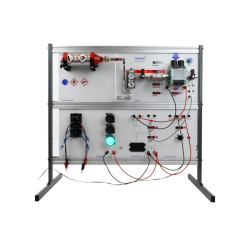
200 W Photovoltaic Training System


Hera_carre.jpg

Reference 530.801.000


For Off-Grid and Grid-Connected Applications

The 200 W Photovoltaic Training System is designed to provide a comprehensive understanding of solar power generation and photovoltaic system operation. It enables students and trainees to explore the fundamental principles of solar energy production while gaining hands-on experience with real measurement and analysis tools.

This educational platform allows users to study the electrical characteristics of photovoltaic modules, including the determination of the Maximum Power Point (MPP). It also demonstrates how various environmental factors influence the performance and efficiency of solar panels, such as:

  • Partial shading of the module
  • Solar incidence angle
  • Panel inclination
  • Light intensity
  • Module temperature

The system enables practical experiments and measurements in both DC and AC circuits, allowing users to observe the behavior of the photovoltaic system under different environmental and operating conditions.

Measurement data can be easily recorded, analyzed, and visualized on a computer using the included dual-channel digital multimeter with USB interface, together with the supplied data acquisition software. This allows users to generate graphs, compare results, and better understand the relationship between environmental conditions and energy production.

This training system is particularly suitable for technical education, vocational training, engineering programs, and renewable energy laboratories.

Electrical consumption (full lighting configuration):
3'200 W


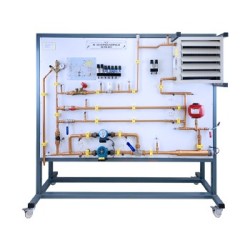
HS-105 - Efficiency in Heating Technology


Logo ADF Didactic

Reference : HS-105


The HS-105 is a complete educational training system designed for the study of energy efficiency in heating technology. It features a fully functional closed-loop heating circuit for analyzing performance, pressure losses, and system behavior.

Equipped with advanced sensors and software, the system allows real-time visualization of energy flows, control response analysis, and comparison between different circulating pump technologies.

🎯 Educational Applications

  • Heating system analysis
  • Energy efficiency studies
  • PID control training
  • Pump technology comparison


Hydrogen Generator with Photovoltaic Bench


Logo Heliocentris

References :

  • SHE-811 Solar Hydrogen Extension 30 nl/h
  • SHE-812 Solar Hydrogen Extension 72 nl/h


The Solar Hydrogen Trainer is a 400 Wp off-grid photovoltaic system combined with an electrolyzer for on-site hydrogen production. Using clean solar energy, the system generates hydrogen sustainably and can be integrated with the Fuel Cell Trainer or the Nexa® Training System to form a comprehensive micro-laboratory platform.

The system enables complete energy balancing of the solar hydrogen generation process. Performance and production data from the PV modules, power electronics, battery storage, and electrolyzer are displayed in the included software and can be logged and exported for further analysis. Energy flows between individual components are clearly visualized, providing full system transparency.

Mobile solar modules with adjustable tilt angles and optional solar sensors allow for advanced experimentation in photovoltaic performance and system optimization.


Key Features

  • Fundamentals of solar photovoltaic power generation
  • Operating principles of off-grid solar systems
  • Efficiency analysis of solar hydrogen production
  • System dimensioning of solar hydrogen applications
  • Dedicated focus on Power-to-Gas training concepts

Sample Experiments

  • Optimization of solar module alignment
  • Determination of electrolyzer efficiency
  • Performance analysis and behavior of photovoltaic modules