Process Eng.

Process Eng.


El Eslèk provides advanced solutions for process engineering laboratories, designed for engineering schools, technical universities, training centers, and industrial research departments. Our equipment is developed to deliver hands-on learning experiences, enabling students and professionals to understand, analyze, and optimize industrial processes in a safe and controlled environment.


Our offerings cover a wide range of process engineering fields, including chemical processes, fluid dynamics, heat and mass transfer, process control, unit operations, and industrial automation. These solutions allow learners to simulate, monitor, and optimize process operations, bridging the gap between theoretical knowledge and practical industrial applications.


Developed in collaboration with process engineers, educators, and industry experts, our laboratory systems ensure precision, reliability, and pedagogical effectiveness, fully aligned with academic curricula and the evolving needs of modern process industries.


Driven by a commitment to excellence, El Eslèk delivers high-quality process engineering laboratory equipment at competitive conditions, while providing continuous innovation, expert technical support, and an optimal user experience, supporting both educational success and professional competency in process engineering.


Process Eng.

Active filters

FluidLab-PA Closed-Loop



Festo Logo

Reference : 8208217


Step-by-Step Exploration of the Fundamentals of Control Engineering

FluidLab-PA Closed-Loop is an intuitive software platform designed to explore and demonstrate the core principles of control engineering in a structured and practical way.

The software enables measurement, control, and regulation of pressure, temperature, flow, and level control loops using either real or simulated hardware systems, including EduKit PA, MPS PA Compact Workstation, MPS PA Stations, and EDS Water Management systems.


Learning Objectives

  • Master the fundamental principles of control engineering
  • Apply control technology concepts in practical scenarios
  • Integrate hardware components into a complete control system
  • Customize system parameters (sensor values, signal attenuation, simulation modes)
  • Analyze and interpret process data

Key Advantages

  • Provides a realistic and interactive platform that immerses learners in real-world process control scenarios
  • Advanced visualization of complex continuous control and regulation systems
  • Enhances engagement through graphical documentation display and real-time system feedback
  • Customizable parameters to support individualized learning and experimentation
  • Seamless integration with physical training systems for hands-on experience


FluidLab-PA Process


Festo Logo

Reference : 8208223


Introducing Students to Process Engineering with Real or Simulated Training Systems

FluidLab-PA Process is designed to provide an accessible introduction to process engineering using either real or simulated learning systems.

The software supports commissioning, operation, and monitoring of EduKit PA as well as selected workstations from the MPS PA and EDS Water Management systems. It promotes a solid understanding of process control engineering principles through structured and application-oriented learning.


Learning Objectives

  • Understand plant behavior, process operations, and different control strategies
  • Develop commissioning skills to ensure safe and efficient system operation
  • Monitor machine status, manage alarms, and analyze deviations
  • Program process sequences using electrical circuit diagrams, logic diagrams, and GRAFCET

Key Advantages

  • Interactive training that reinforces theoretical knowledge through practical application
  • Redesigned interface ensuring a consistent operating concept across all hardware systems
  • Seamless switching between real and simulated systems, enabling remote learning and curriculum expansion without additional hardware investment
  • Modern software architecture allowing easy integration of additional equipment and updates


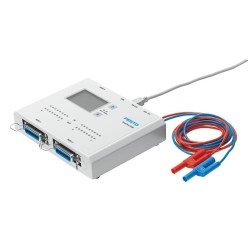
EasyPort Interface


Festo Logo

Reference : 548687


Technical Features

  • 16 digital inputs/outputs
  • 4 analog inputs and 2 analog outputs
  • 8 digital inputs/outputs each wired to a 24-pin SysLink connector (IEEE 488 compliant)
  • Digital input 0 on Port 1 and Port 2 configurable as high-speed counter input
  • Counter inputs operable with voltage levels from 5 to 24 V DC
  • Analog I/O connected via a 15-pin Sub-D connector
  • 12-bit analog-to-digital conversion resolution
  • Sampling rate: 0.5 kHz
  • Data communication via RS232 serial interface or USB
  • Transmission rate: 115.2 kbaud

Up to four EasyPort USB modules can be connected simultaneously via a USB hub or four separate USB ports on a PC. Each module must be assigned a unique address.

For signal exchange between EasyPort USB and PC software, the EzOPC OPC server or the EasyPort USB ActiveX control component is available.


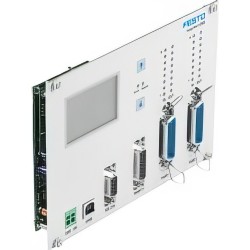
EasyPort Interface, 19" version


Festo Logo

Reference : 8021637


Technical Features

  • 16 digital inputs/outputs
  • 4 analog inputs and 2 analog outputs
  • 8 digital inputs/outputs each wired to a 24-pin SysLink connector (IEEE 488 compliant)
  • Digital input 0 on Port 1 and Port 2 configurable as high-speed counter input
  • Counter inputs operable with voltage levels from 5 to 24 V DC
  • Analog I/O connected via a 15-pin Sub-D connector
  • 12-bit analog-to-digital conversion resolution
  • Sampling rate: 0.5 kHz
  • Data communication via RS232 serial interface or USB
  • Transmission rate: 115.2 kbaud

Up to four EasyPort USB modules can be connected simultaneously via a USB hub or four separate USB ports on a PC. Each module must be assigned a unique address.

For signal exchange between EasyPort USB and PC software, the EzOPC OPC server or the EasyPort USB ActiveX control component is available.


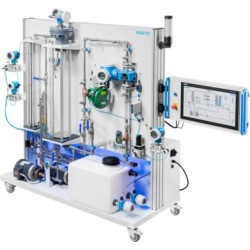
DCS Learning System (PCS neo)


Festo Logo

Reference : 8232218


Process Workstation

Process Equipment

  • Industrial stainless-steel piping
  • Polyethylene tank – 60.6 L (16 US gal)
  • Large acrylic column with sparger tube and stainless-steel baffle – 30.4 L (8.0 US gal)
  • Small acrylic column – 7.6 L (2.0 US gal)
  • High-capacity brass centrifugal pump – 0.75 kW (1 HP), 208 V
  • Medium-capacity brass centrifugal pump – 0.75 kW (1 HP), 208 V
  • Two SIMATIC G120 variable frequency drives – 0.75 kW
  • 2-way ball valve with manual lever, flow coefficient Kv = 59 m³/h
  • Manual ball valve
  • Check valve with flow coefficient Kv = 9.482 m³/h
  • 20 stainless-steel pressure tapping points
  • Emerson pneumatically actuated ball valve (12 mm / ½"), Kv = 5.16 (Cv = 6), control range 21–90 kPa (3–13 psi)
  • Festo VPPM digital proportional pressure regulator
  • Pressure gauge – 0–690 kPa (0–100 psi)
  • Rotameter – 0–80 LPM (0–20 US gpm)
  • Festo VZWM solenoid valve – 24 V DC
  • Festo VZXF pneumatically piloted angle-seat control valve

Control Components

  • SIMATIC IPC BX-32 with SIMATIC PCS neo V6.0 license and database
  • Siemens CPU410-5H
  • SIMATIC ET 200SP HA IM155-6 PN interface module
  • SIMATIC ET 200SP HA BA 2xRJ45 bus adapter with dual RJ45 ports
  • SIMATIC ET 200SP HA DI 16x24VDC digital input module with channel diagnostics
  • SIMATIC ET 200SP HA AI 16xI 2-wire HART analog input module, 16-bit, with channel diagnostics
  • SIMATIC ET 200SP HA AQ 8xI HART analog output module, 16-bit, with channel diagnostics
  • SCALANCE XC208 managed Layer 2 industrial Ethernet switch
  • Pepperl+Fuchs PPA Ethernet-APL / Profibus PA switch
  • Siemens IPC BX-32A
  • 22” flat panel display (IFP2200)
  • Electronically configurable signal tower with 9 segments and acoustic module
  • SITOP PSU8200 stabilized power supply – 24 V / 20 A
  • SITOP PSE200U 4-channel electronic protection module

Instrumentation (Endress+Hauser)

  • PTC31B pressure switch (IO-Link®)
  • PMD75B differential pressure transmitter (high range, PROFINET over Ethernet-APL, Bluetooth®, Heartbeat Technology)
  • TH15 temperature transmitter with Pt100 RTD (HART®, Bluetooth®)
  • TH55 temperature transmitter with Type J thermocouple (HART®, Bluetooth®)
  • 5P3B15 electromagnetic flowmeter (HART®, WLAN, Heartbeat Technology)
  • FMR51 + FHX50 radar level transmitter with remote display (Bluetooth®, Heartbeat Technology)
  • PMD75B + DA63M differential pressure transmitter with 3-valve manifold for Venturi flow measurement (low range, HART®, Bluetooth®, Heartbeat Technology)
  • PMD75B differential pressure transmitter for level measurement (low range, PROFIBUS PA, Bluetooth®, Heartbeat Technology)

Gas (Air) Control

  • Festo SPAU pressure sensor with display (IO-Link®)
  • Festo VEMD mass flow meter with display and dynamic control (2–100 LPM, Modbus®)
  • Festo MS6N precision pressure regulators – 5–255 kPa (0.7–37 psi), flow rate 1098 LPM (38.8 scfm)


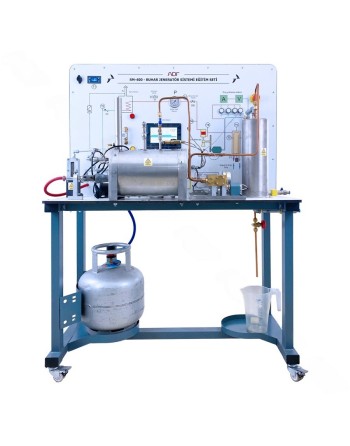
SM-400 – Steam Power Plant Trainer


Logo ADF Didactic

Reference : SM-400


The SM-400 is a complete educational system designed to demonstrate the operation of a steam power plant. It showcases the conversion of thermal energy into mechanical and electrical energy within a realistic and fully instrumented setup.

Description

In a steam power plant, thermodynamic energy from steam pressure is converted into mechanical energy and then into electricity. The SM-400 accurately reproduces this process using real industrial components adapted for educational use.

The system includes a gas-fired boiler for steam generation, a single-cylinder piston steam engine, an electrical generator, a water-cooled condenser, a feed water tank, and a feed water pump. The generated electrical energy is used to power light bulbs, representing real consumers.

Exhaust steam is condensed in a water-cooled condenser, ensuring a closed-loop cycle. Sensors allow real-time monitoring of temperature, pressure, flow rate, voltage, and current.

Key Features

  • Complete demonstration of a steam power plant
  • Real energy conversion: thermal → mechanical → electrical
  • Fully instrumented system with live data display
  • Safe operation with safety valve and temperature monitoring
  • Ideal for technical and scientific education


CP-120 - Biotechnical Ethanol Production Unit


Logo ADF Didactic

Référence : CP-120


General Description

The CP-120 is a complete laboratory and pilot-scale unit designed for batch conversion of starch-based raw materials into ethanol. It integrates mashing, fermentation, and distillation processes with advanced automation control.

Main Features

Integrated Process

  • Mash tank with agitator and water jacket cooling
  • Steam injection for thermal processing
  • Closed fermentation tank with thermal control
  • Distillation unit with 3 bubble cap trays

Control and Automation

  • pH control via metering pumps (acid and caustic)
  • PID regulation for temperature and flow rates
  • PLC control with touchscreen interface
  • Data acquisition software via USB (Windows 8/10)


EduKit-PA - Kit for a Processing Station


Festo Logo

References :

  • Basic Version : 549822
  • Advanced Version : 564631 (Add-on)


The EduKit-PA Process Automation Kit is a comprehensive educational solution designed to provide structured, hands-on training in process automation, mechatronics, and Industry 4.0 technologies. Its modular architecture supports progressive learning — from fundamental principles to fully software-controlled automation systems.

Key Advantages

  • Structured introduction to mechatronics, automation technology, and core Industry 4.0 concepts
  • Highly modular design enabling scalable learning: from standalone modules to complete workstations and software-controlled learning factories
  • Flexible configuration allowing independent system modifications and project-based expansion
  • Comprehensive instructional materials that break complex topics into manageable learning units
  • Dedicated educational software environment built around a Manufacturing Execution System (MES) developed specifically for teaching
  • Integration of modern learning tools such as QR codes and augmented reality for enhanced interaction and engagement