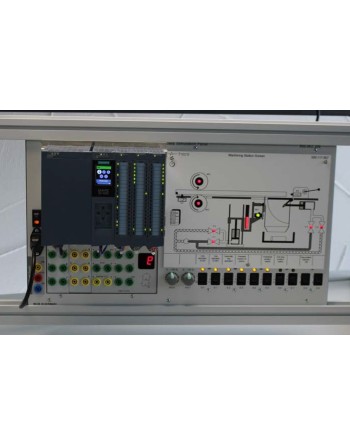
Electrical Eng.

Electrical Eng.


El Eslèk provides comprehensive solutions for electrical engineering laboratories, designed for engineering schools, technical universities, training centers, and research departments. Our equipment is engineered to deliver advanced hands-on experiences, allowing students and professionals to master the principles and practical applications of electrical engineering in a safe and realistic environment.


Our offerings cover a wide range of fields, including electrotechnics, electronics, control systems, renewable energy, electric machines, and smart electrical networks. These solutions enable learners to design, test, and analyze electrical circuits and systems, while developing practical skills directly applicable to industry and research.


Developed in collaboration with experienced engineers and specialized educators, our equipment provides precise, durable, and pedagogically effective tools, fully aligned with academic curricula and the modern requirements of electrical engineering education.


Committed to excellence, El Eslèk delivers high-quality electrical engineering laboratory equipment at competitive conditions, while ensuring continuous innovation, reliable technical support, and an optimal user experience, supporting both educational success and professional skill development.


Electrical Eng.

Active filters

GDB-03 Oscilloscope Education and Training Kit


Logo GW Instek


Key Features

  • Designed for oscilloscope demonstration and training
  • Compatible with GDS-3000 / GDS-2000A / MSO-2000A / GDS-2000E series
  • Integrated signal generator for real-world waveform simulation
  • 5 V DC power input with USB power support (Type-B interface)


FluidLab-PA Closed-Loop


Festo Logo

Reference : 8208217


Step-by-Step Exploration of the Fundamentals of Control Engineering

FluidLab-PA Closed-Loop is an intuitive software platform designed to explore and demonstrate the core principles of control engineering in a structured and practical way.

The software enables measurement, control, and regulation of pressure, temperature, flow, and level control loops using either real or simulated hardware systems, including EduKit PA, MPS PA Compact Workstation, MPS PA Stations, and EDS Water Management systems.


Learning Objectives

  • Master the fundamental principles of control engineering
  • Apply control technology concepts in practical scenarios
  • Integrate hardware components into a complete control system
  • Customize system parameters (sensor values, signal attenuation, simulation modes)
  • Analyze and interpret process data

Key Advantages

  • Provides a realistic and interactive platform that immerses learners in real-world process control scenarios
  • Advanced visualization of complex continuous control and regulation systems
  • Enhances engagement through graphical documentation display and real-time system feedback
  • Customizable parameters to support individualized learning and experimentation
  • Seamless integration with physical training systems for hands-on experience


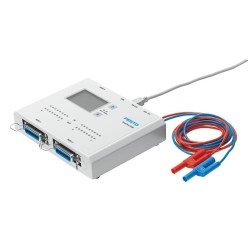
EasyPort Interface


Festo Logo

Reference : 548687


Technical Features

  • 16 digital inputs/outputs
  • 4 analog inputs and 2 analog outputs
  • 8 digital inputs/outputs each wired to a 24-pin SysLink connector (IEEE 488 compliant)
  • Digital input 0 on Port 1 and Port 2 configurable as high-speed counter input
  • Counter inputs operable with voltage levels from 5 to 24 V DC
  • Analog I/O connected via a 15-pin Sub-D connector
  • 12-bit analog-to-digital conversion resolution
  • Sampling rate: 0.5 kHz
  • Data communication via RS232 serial interface or USB
  • Transmission rate: 115.2 kbaud

Up to four EasyPort USB modules can be connected simultaneously via a USB hub or four separate USB ports on a PC. Each module must be assigned a unique address.

For signal exchange between EasyPort USB and PC software, the EzOPC OPC server or the EasyPort USB ActiveX control component is available.


FluidLab-PA Process


Festo Logo

Reference : 8208223


Introducing Students to Process Engineering with Real or Simulated Training Systems

FluidLab-PA Process is designed to provide an accessible introduction to process engineering using either real or simulated learning systems.

The software supports commissioning, operation, and monitoring of EduKit PA as well as selected workstations from the MPS PA and EDS Water Management systems. It promotes a solid understanding of process control engineering principles through structured and application-oriented learning.


Learning Objectives

  • Understand plant behavior, process operations, and different control strategies
  • Develop commissioning skills to ensure safe and efficient system operation
  • Monitor machine status, manage alarms, and analyze deviations
  • Program process sequences using electrical circuit diagrams, logic diagrams, and GRAFCET

Key Advantages

  • Interactive training that reinforces theoretical knowledge through practical application
  • Redesigned interface ensuring a consistent operating concept across all hardware systems
  • Seamless switching between real and simulated systems, enabling remote learning and curriculum expansion without additional hardware investment
  • Modern software architecture allowing easy integration of additional equipment and updates


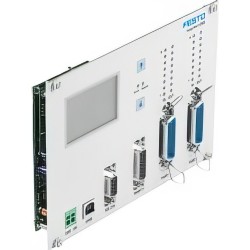
EasyPort Interface, 19" version


Festo Logo

Reference : 8021637


Technical Features

  • 16 digital inputs/outputs
  • 4 analog inputs and 2 analog outputs
  • 8 digital inputs/outputs each wired to a 24-pin SysLink connector (IEEE 488 compliant)
  • Digital input 0 on Port 1 and Port 2 configurable as high-speed counter input
  • Counter inputs operable with voltage levels from 5 to 24 V DC
  • Analog I/O connected via a 15-pin Sub-D connector
  • 12-bit analog-to-digital conversion resolution
  • Sampling rate: 0.5 kHz
  • Data communication via RS232 serial interface or USB
  • Transmission rate: 115.2 kbaud

Up to four EasyPort USB modules can be connected simultaneously via a USB hub or four separate USB ports on a PC. Each module must be assigned a unique address.

For signal exchange between EasyPort USB and PC software, the EzOPC OPC server or the EasyPort USB ActiveX control component is available.


TE-101 - Temperature Measurement Training Set


Logo ADF Didactic

Reference : TE-101


The TE-101 is a comprehensive training system designed for studying and comparing different temperature measurement methods used in industrial and scientific environments.

It enables analysis of both mechanical and electronic measurement techniques, including steady-state and transient thermal behavior.

🔍 General Description

Various physical principles are used to measure temperature. The TE-101 allows users to observe and compare these methods under real operating conditions using both analog and electronic instruments.

Temperature sensors are mounted on a height-adjustable platform, allowing immersion in a heated water tank up to 80°C. A fan ensures nearly constant ambient conditions, while a second tank with an electronically controlled heater provides precise temperature control.

Measured values can be displayed in analog or digital form and recorded continuously using a 3-channel line recorder, making it possible to analyze response times and temperature variations.

⚙️ Key Features

  • Steady-state and transient temperature measurement
  • Comparison of multiple sensor technologies
  • Controlled temperature steps up to 80°C
  • Analog and digital measurement display
  • Continuous data recording (3-channel recorder)
  • Stable ambient conditions ensured by integrated fan
  • HDMI panel interface

🎯 Applications

  • Technical and academic training
  • Educational laboratories
  • Sensor and instrumentation studies
  • Thermal control system analysis

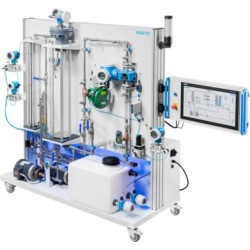
DCS Learning System (PCS neo)


Festo Logo

Reference : 8232218


Process Workstation

Process Equipment

  • Industrial stainless-steel piping
  • Polyethylene tank – 60.6 L (16 US gal)
  • Large acrylic column with sparger tube and stainless-steel baffle – 30.4 L (8.0 US gal)
  • Small acrylic column – 7.6 L (2.0 US gal)
  • High-capacity brass centrifugal pump – 0.75 kW (1 HP), 208 V
  • Medium-capacity brass centrifugal pump – 0.75 kW (1 HP), 208 V
  • Two SIMATIC G120 variable frequency drives – 0.75 kW
  • 2-way ball valve with manual lever, flow coefficient Kv = 59 m³/h
  • Manual ball valve
  • Check valve with flow coefficient Kv = 9.482 m³/h
  • 20 stainless-steel pressure tapping points
  • Emerson pneumatically actuated ball valve (12 mm / ½"), Kv = 5.16 (Cv = 6), control range 21–90 kPa (3–13 psi)
  • Festo VPPM digital proportional pressure regulator
  • Pressure gauge – 0–690 kPa (0–100 psi)
  • Rotameter – 0–80 LPM (0–20 US gpm)
  • Festo VZWM solenoid valve – 24 V DC
  • Festo VZXF pneumatically piloted angle-seat control valve

Control Components

  • SIMATIC IPC BX-32 with SIMATIC PCS neo V6.0 license and database
  • Siemens CPU410-5H
  • SIMATIC ET 200SP HA IM155-6 PN interface module
  • SIMATIC ET 200SP HA BA 2xRJ45 bus adapter with dual RJ45 ports
  • SIMATIC ET 200SP HA DI 16x24VDC digital input module with channel diagnostics
  • SIMATIC ET 200SP HA AI 16xI 2-wire HART analog input module, 16-bit, with channel diagnostics
  • SIMATIC ET 200SP HA AQ 8xI HART analog output module, 16-bit, with channel diagnostics
  • SCALANCE XC208 managed Layer 2 industrial Ethernet switch
  • Pepperl+Fuchs PPA Ethernet-APL / Profibus PA switch
  • Siemens IPC BX-32A
  • 22” flat panel display (IFP2200)
  • Electronically configurable signal tower with 9 segments and acoustic module
  • SITOP PSU8200 stabilized power supply – 24 V / 20 A
  • SITOP PSE200U 4-channel electronic protection module

Instrumentation (Endress+Hauser)

  • PTC31B pressure switch (IO-Link®)
  • PMD75B differential pressure transmitter (high range, PROFINET over Ethernet-APL, Bluetooth®, Heartbeat Technology)
  • TH15 temperature transmitter with Pt100 RTD (HART®, Bluetooth®)
  • TH55 temperature transmitter with Type J thermocouple (HART®, Bluetooth®)
  • 5P3B15 electromagnetic flowmeter (HART®, WLAN, Heartbeat Technology)
  • FMR51 + FHX50 radar level transmitter with remote display (Bluetooth®, Heartbeat Technology)
  • PMD75B + DA63M differential pressure transmitter with 3-valve manifold for Venturi flow measurement (low range, HART®, Bluetooth®, Heartbeat Technology)
  • PMD75B differential pressure transmitter for level measurement (low range, PROFIBUS PA, Bluetooth®, Heartbeat Technology)

Gas (Air) Control

  • Festo SPAU pressure sensor with display (IO-Link®)
  • Festo VEMD mass flow meter with display and dynamic control (2–100 LPM, Modbus®)
  • Festo MS6N precision pressure regulators – 5–255 kPa (0.7–37 psi), flow rate 1098 LPM (38.8 scfm)


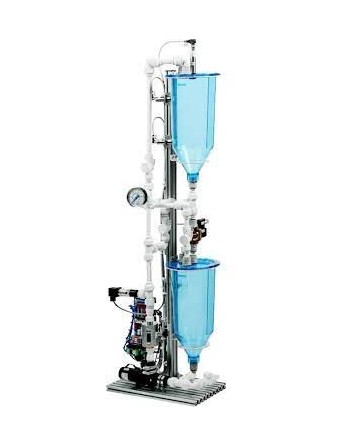
EduKit-PA - Kit for a Processing Station


Festo Logo

References :

  • Basic Version : 549822
  • Advanced Version : 564631 (Add-on)


The EduKit-PA Process Automation Kit is a comprehensive educational solution designed to provide structured, hands-on training in process automation, mechatronics, and Industry 4.0 technologies. Its modular architecture supports progressive learning — from fundamental principles to fully software-controlled automation systems.

Key Advantages

  • Structured introduction to mechatronics, automation technology, and core Industry 4.0 concepts
  • Highly modular design enabling scalable learning: from standalone modules to complete workstations and software-controlled learning factories
  • Flexible configuration allowing independent system modifications and project-based expansion
  • Comprehensive instructional materials that break complex topics into manageable learning units
  • Dedicated educational software environment built around a Manufacturing Execution System (MES) developed specifically for teaching
  • Integration of modern learning tools such as QR codes and augmented reality for enhanced interaction and engagement


FCS3000 - Fuel Cell Simulation Software


Logo ITECH


Reference

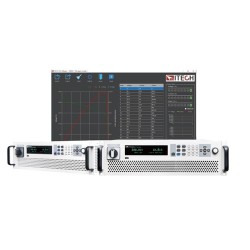
FCS3000 Fuel Cell Simulation Software


The FCS3000 Fuel Cell Simulation Software, when used in combination with the IT6000C bidirectional DC power supply and the IT6000B regenerative power system, enables accurate simulation of fuel cell stack polarization curves.

The system supports output voltages up to 2250 V and scalable power up to 1152 kW, meeting the requirements of high-power fuel cell simulation applications.

FCS3000 is specifically designed to replace real fuel cell stacks in laboratory environments, providing a highly efficient and flexible simulation platform for hydrogen energy and hybrid propulsion system research.

By eliminating the need for physical fuel cell stacks, the software helps reduce testing costs, simplify platform setup, and avoid performance degradation commonly associated with repeated experimental use of real fuel cell systems.

With its intuitive user interface and comprehensive data reporting capabilities, FCS3000 provides reliable experimental support for both practical testing and theoretical research.


Key Features

  • Automatic wide-range output with voltage up to 2250 V
  • Scalable fuel cell simulation power up to 1152 kW
  • User-defined fuel cell polarization curve with up to 4096 programmable points
  • Support for .csv file import for customized curve simulation
  • Data storage and export functions for analysis and reporting
  • Graphical software interface with real-time display of output voltage, current, and power


SAS1000 - Solar Array Simulation Software


Logo ITECH


References

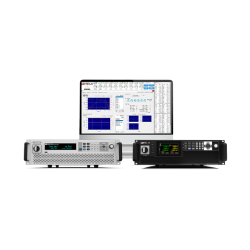
SAS1000 Solar array software for IT6500C/IT6000B/IT6000C/IT-M3600

SAS1000L Solar array software for IT6500C/IT6000B/IT6000C/IT-M3600 (power ≤15kW)

SAS1000M Solar array software for IT6500C/IT6000B/IT6000C/IT-M3600 (multi-channel)


ITECH introduces its latest high-speed, high-performance photovoltaic simulation solution. When combined with high-power DC power supplies, the SAS1000/L solar array simulation software accurately reproduces solar array I-V curves, with output voltage up to 2250 V and scalable system power up to 10 MW.

The system delivers fast dynamic response, excellent control accuracy, high repeatability, outstanding stability, and precision performance. It features built-in simulation models compliant with EN 50530, Sandia National Laboratories PV model, NB/T 32004, CGC/GF004, and CGC/GF035.

Users can easily configure test regulations, material types, Vmp, Pmp, and other parameters to simulate I-V curve characteristics and automatically generate test reports. The software is ideal for static and dynamic maximum power point tracking (MPPT) performance testing of photovoltaic inverters.


Product Features

  • Automatic wide-range output, with voltage up to 2250 V
  • Scalable power up to 10 MW
  • Built-in I-V curve mathematical model for accurate solar array simulation
  • Simulation of various solar cell technologies (monocrystalline, polycrystalline, thin-film), including Fill Factor configuration
  • I-V curve simulation under varying temperature and irradiation conditions
  • Shading simulation for solar panels (e.g., cloud or tree shadow scenarios)
  • Static and dynamic MPPT efficiency testing
  • Built-in EN 50530, Sandia National Laboratories PV model, NB/T 32004, CGC/GF004, and CGC/GF035 test programs with automatic report generation
  • Graphical user interface with real-time MPPT status monitoring
  • Automatic programming of up to 100 I-V curves via Voc, Isc, FF, Pm, and other parameter points
  • Support for 100 × 128-point curves and 4096-point high-resolution programming
  • Adjustable output impedance
  • Independent edge configuration for multiple operating modes, with adjustable rise and fall times
  • Seamless bidirectional current switching for rapid cell charge and discharge simulation/li>
  • Built-in DIN 40839 and ISO 16750-2 compliance
  • Standard USB, RS232, GPIB, and LAN (LXI compliant) interfaces
  • Support for up to 20 solar power supplies for multi-channel MPPT testing

Applications

  • Design and validation of PV inverter MPPT circuits and algorithms
  • Verification of inverter MPP voltage range and full-load MPP voltage range/li>
  • Validation of static maximum power tracking efficiency
  • Dynamic MPPT performance testing according to EN 50530, Sandia National Laboratories PV model, NB/T 32004, CGC/GF004, and CGC/GF035
  • Verification of inverter start-up voltage, maximum input voltage, maximum input current, and related electrical parameters
  • MPPT validation under partial shading conditions
  • DC terminal protection testing (OVP, OPP)
  • Validation of microgrid control centers and photovoltaic energy storage control functions
  • MPPT performance verification from sunrise to sunset operating conditions
  • Total and conversion efficiency testing of inverters when used with the IT9100 power analyzer


MecLab® - Basics to Mechatronic


Festo Logo

Reference : 549786


Automation Training System

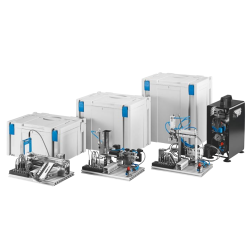
Automated systems are now an integral part of nearly every industry. With the MecLab® system from Festo Didactic, students gain a practical understanding of how automation technology is applied in real production environments.

The three MecLab stations represent simplified models of typical production processes found in modern automated manufacturing facilities. They provide a realistic yet accessible platform for learning the fundamentals of industrial automation.


Learning Objectives

MecLab® covers a wide range of topics and competencies, including:

  • Introduction to key terminology in industrial automation
  • Planning, development, and implementation of automated systems
  • Technical documentation practices
  • System modeling and simulation development
  • Open-loop and closed-loop control systems
  • Pneumatic and electrical actuators, sensors, and controllers
  • Use of the computer as a tool for programming and simulation


MPS®400-1 - Modular Production System i4.0


Festo Logo


MPS 400-1 System – Festo Didactic

Comprehensive, modular learning factory for advanced education in mechatronics, automation, and Industry 4.0

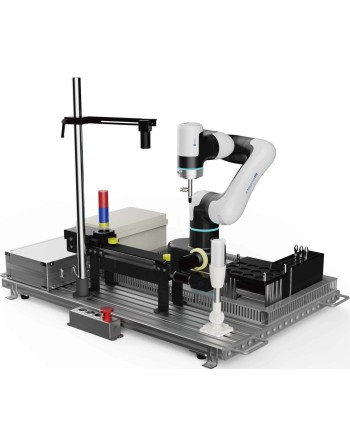
The MPS 400-1 system developed by Festo Didactic is a fully integrated and highly realistic training solution designed to replicate the structure, behavior, and complexity of modern industrial production systems. Based on the modular and industry-proven MPS 400 platform, this learning factory provides a complete environment for teaching and experimenting with the core technologies of Industry 4.0.

The system is composed of three main stations — Distribution Pro, Assembly, and Inline Sorting — forming a coherent and fully automated production line. Each station represents a key stage of industrial manufacturing, from raw material handling to assembly and quality control.

Thanks to its modular architecture, the MPS 403-1 system can be extended with one or two additional stations, such as the Measure Pro station for industrial metrology and the Robotic Assembly station for advanced robotics applications. This scalability allows educators to adapt the system to different levels of training, from basic automation to highly advanced smart factory scenarios.

All stations are interconnected through modern industrial communication protocols, including OPC UA, IO-Link®, PROFINET, and TCP/IP. The entire system is orchestrated by a didactic Manufacturing Execution System (MES), enabling real-time production control, order management, traceability, and data-driven decision-making. 

Integrated Technologies

  • Didactic MES system with web-based interface
  • RFID technology for product traceability
  • IO-Link smart sensors for advanced diagnostics
  • OPC UA and PROFINET for industrial communication
  • IIoT solutions with camera and embedded systems
  • Machine learning algorithms for process optimization
  • Modern HMI systems including touchscreen and web interfaces
  • Augmented Reality (AR) support for interactive learning

Applications

The MPS 403-1 system is suitable for a wide range of educational and industrial training environments:

  • Universities and engineering schools
  • Technical and vocational training centers
  • Industry 4.0 laboratories and innovation hubs
  • Corporate training programs
  • Advanced research and development projects

By combining modular hardware, modern software, and cutting-edge industrial technologies, the MPS 403-1 system provides a future-proof platform for training the next generation of engineers and technicians.

Process Simulation Panel for Simatic PLC


Hera_carre.jpg

References :

  • 950.062.200 Process Simulation Panel for PLC S7-1500
  • 950.032.800 Process Simulation Panel for PLC S7-1200


General Description

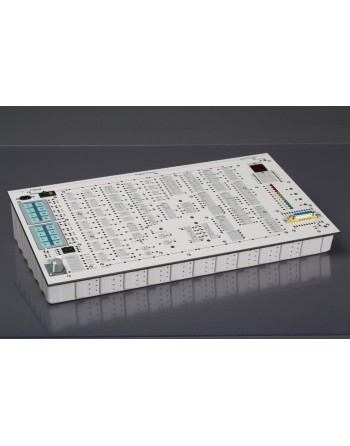
The PLC Process Simulation Panel provides a practical and efficient solution for simulating industrial processes without the need for PC-based software. Output signals are visualized directly through LEDs, running lights, a 7-segment display, and an acoustic buzzer.

This system is ideal for training, testing, and validating PLC programs in both educational and industrial environments.


Included Process Simulations

The panel includes multiple pre-configured process simulations:

  • Star-Delta Connection
  • Staircase Lighting
  • Intruder Alarm System
  • Traffic Lights (traffic-dependent and independent)
  • Conveyor Belt with Buffer Storage
  • Segment Gate Control
  • Machining Station
  • Bottling Plant
  • Mixing Vessel


Compatibility and Integration

The panel is equipped with a DIN rail for mounting Siemens PLCs, including:

  • Siemens S7-1200 (e.g., S7-1215C DC/DC/DC)
  • Siemens S7-1500 (e.g., S7-1512C-1PN)
  • ET200S for decentralized control

It can also be controlled using an external PLC via 4 mm input/output connectors.


Training Module: Basics to Operational Amplifiers


Hera_carre.jpg


Reference :

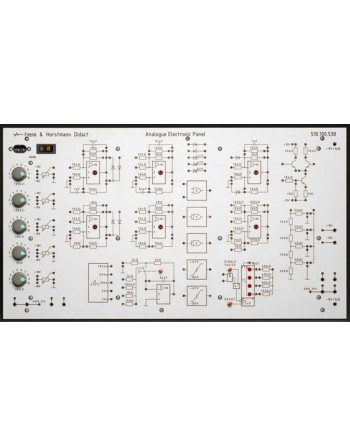
  • 510.100.530 – Module amplificateur opérationnel


Overview

The Operational Amplifier Panel is a compact and comprehensive training system designed to provide in-depth knowledge of operational amplifier (op-amp) circuits. It is ideally suited for learning, designing, and troubleshooting electronic laboratory devices.

The panel is equipped with 11 μA741 operational amplifiers and 5 potentiometers for precise voltage adjustment, making it an efficient educational tool for technical training environments and laboratories.


Learning Content

  • Differential amplifier
  • Inverting and non-inverting circuits
  • Impedance converter
  • Calculation circuits (summing, subtraction, multiplication)
  • Comparator circuits (threshold switch, Schmitt trigger)
  • Constant current and constant voltage sources
  • Precision voltage source and precision rectifier circuits
  • Astable and monostable multivibrators
  • Integrator
  • Function generator (triangle, sawtooth)
  • Differentiator
  • RC oscillator with op-amp
  • AC voltage amplifier
  • Squaring and root extraction using diode networks
  • A/D and D/A converters with R-2R networks
  • Divider and root extraction


Training Module: Basics of Power Electronics


Hera_carre.jpg


Reference :

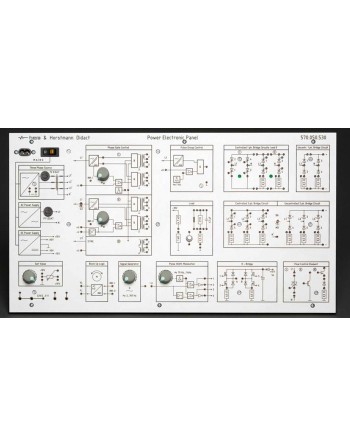
  • 570.050.530 – Power Electronics Panel


Overview

The Power Electronics Panel is a compact training system designed for performing experiments in power electronics on DC, single-phase AC, and three-phase AC circuits using a safe low-voltage approach.

The panel includes integrated resistive, inductive, and capacitive loads, enabling a comprehensive understanding of power electronics behavior and applications.

An optional motor/generator module can be added to extend the system capabilities to electromechanical and control system applications.


Single-phase AC Experiments

  • Uncontrolled half-wave rectifier
  • Uncontrolled bridge rectifier
  • Half-controlled bridge rectifier
  • Fully controlled bridge rectifier
  • Line-commutated rectifier
  • Pulse group control


Three-phase AC Experiments

  • Uncontrolled rectifier M3
  • Uncontrolled rectifier B6
  • Controlled rectifier M3
  • Controlled rectifier B6


DC Experiments

  • Basic PWM circuits
  • PWM with H-bridge (MOSFET)


GTO Experiments

  • Trigger pulse manipulation
  • GTO used as chopper