



Comprehensive, modular learning factory for advanced education in mechatronics, automation, and Industry 4.0
The MPS 400-1 system developed by Festo Didactic is a fully integrated and highly realistic training solution designed to replicate the structure, behavior, and complexity of modern industrial production systems. Based on the modular and industry-proven MPS 400 platform, this learning factory provides a complete environment for teaching and experimenting with the core technologies of Industry 4.0.
The system is composed of three main stations — Distribution Pro, Assembly, and Inline Sorting — forming a coherent and fully automated production line. Each station represents a key stage of industrial manufacturing, from raw material handling to assembly and quality control.
Thanks to its modular architecture, the MPS 403-1 system can be extended with one or two additional stations, such as the Measure Pro station for industrial metrology and the Robotic Assembly station for advanced robotics applications. This scalability allows educators to adapt the system to different levels of training, from basic automation to highly advanced smart factory scenarios.
All stations are interconnected through modern industrial communication protocols, including OPC UA, IO-Link®, PROFINET, and TCP/IP. The entire system is orchestrated by a didactic Manufacturing Execution System (MES), enabling real-time production control, order management, traceability, and data-driven decision-making.
The MPS 403-1 system is suitable for a wide range of educational and industrial training environments:
By combining modular hardware, modern software, and cutting-edge industrial technologies, the MPS 403-1 system provides a future-proof platform for training the next generation of engineers and technicians.

The MPS 403-1 system is designed to provide a holistic learning experience covering the entire industrial value chain. It enables learners to understand not only individual components and technologies but also their interaction within a complex cyber-physical production system.
Students and trainees progressively acquire both theoretical knowledge and hands-on skills in the following areas:
The production workflow begins with the creation of a manufacturing order through an intuitive MES user interface. This interface allows users to configure product variants, define process parameters, and initiate production runs.
Each workpiece is uniquely identified using RFID technology, which ensures full traceability and enables decentralized decision-making throughout the production process.
At the Distribution station, raw parts are automatically fed into the system and assigned digital identities. The Assembly station then reads the RFID data and performs customized operations depending on the specific production order. Finally, the Inline Sorting station verifies product quality and routes the workpieces according to predefined criteria or measurement results.
In advanced configurations, the system can be divided into multiple production cells. In such cases, a mobile robot (Robotino) can be used to transport parts between stations, simulating flexible and decentralized manufacturing environments.

The Distribution Pro station serves as the entry point of the production line. It is responsible for supplying raw parts and initiating the production process.
The station features three stack magazines equipped with intelligent level monitoring. A double-acting pneumatic cylinder ensures precise and reliable separation of individual workpieces. A bidirectional conveyor system then transports the parts to the next station.
The station can operate both in standalone mode and in fully networked MES mode, allowing flexible use in different training scenarios.

The Assembly station performs automated assembly operations based on product specifications and RFID data. It introduces learners to advanced handling systems, sensor technology, and industrial assembly processes.
Workpieces are first transported to a measurement position where their orientation is checked using optical sensors. Only correctly positioned parts are processed further, ensuring realistic quality control conditions.
The station provides a comprehensive understanding of automated assembly systems, including mechanical handling, sensor integration, and control logic.

The Inline Sorting station represents the final stage of the production line, focusing on quality control, classification, and routing of finished products.
A height-adjustable RFID read/write device identifies each workpiece and retrieves its production data. Additional sensors detect physical properties such as color and material, enabling advanced quality verification.
This station introduces learners to modern quality assurance methods, sensor fusion, and data-driven decision-making in industrial environments.

The Measure Pro station focuses on industrial metrology and in-process quality assurance. It enables precise measurement of workpiece characteristics and supports statistical process control (SPC).
This station provides a realistic environment for learning advanced measurement techniques and quality management strategies.

The Robotic Assembly station introduces industrial robotics into the learning factory environment, enabling advanced automation and complex assembly operations.
It is equipped with a Mitsubishi RV-2FRB industrial robot, controlled by a CR800 controller and programmed via a teach pendant. The robot performs multi-step assembly processes, including part handling, inspection, and component integration.
Learners gain hands-on experience in robot programming, system integration, maintenance, and optimization within a real industrial context.

References :
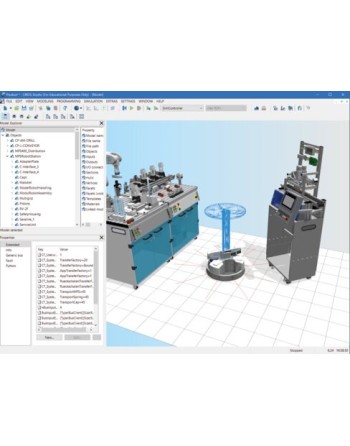
CIROS® 7 is a professional 3D simulation platform designed for industrial automation, robotics and technical training. It enables users to design, simulate and validate automated systems, robotic workcells and production lines in a realistic virtual environment. With extensive model libraries, industrial interfaces and advanced programming capabilities, CIROS® 7 provides a comprehensive solution for education, research and the development of automation skills.
The "Studio" version includes advanced modelling and simulation tools, external controller integration, robot programming, fault simulation and the preparation of educational scenarios. The license allows permanent use of the version available at the time of purchase and includes updates for the following two years.
Comprehensive, modular learning factory for advanced education in mechatronics, automation, and Industry 4.0
The MPS 400-1 system developed by Festo Didactic is a fully integrated and highly realistic training solution designed to replicate the structure, behavior, and complexity of modern industrial production systems. Based on the modular and industry-proven MPS 400 platform, this learning factory provides a complete environment for teaching and experimenting with the core technologies of Industry 4.0.
The system is composed of three main stations — Distribution Pro, Assembly, and Inline Sorting — forming a coherent and fully automated production line. Each station represents a key stage of industrial manufacturing, from raw material handling to assembly and quality control.
Thanks to its modular architecture, the MPS 403-1 system can be extended with one or two additional stations, such as the Measure Pro station for industrial metrology and the Robotic Assembly station for advanced robotics applications. This scalability allows educators to adapt the system to different levels of training, from basic automation to highly advanced smart factory scenarios.
All stations are interconnected through modern industrial communication protocols, including OPC UA, IO-Link®, PROFINET, and TCP/IP. The entire system is orchestrated by a didactic Manufacturing Execution System (MES), enabling real-time production control, order management, traceability, and data-driven decision-making.
The MPS 403-1 system is suitable for a wide range of educational and industrial training environments:
By combining modular hardware, modern software, and cutting-edge industrial technologies, the MPS 403-1 system provides a future-proof platform for training the next generation of engineers and technicians.