
Aircraft Maintenance Training Equipment | EASA Part 147 Solutions | El Eslèk Africa

Avionics


Aviation Maintenance Training Solutions

El Eslèk specializes in the supply of high-end educational equipment dedicated to aviation maintenance training. Our solutions are designed for technical schools, aviation training organizations, and maintenance centers seeking compliance with EASA Part 147 training requirements.


Technical Expertise Dedicated to Education

In close collaboration with our strategic partner ADF Didactic, we continuously develop and integrate innovative training solutions tailored to the evolving technologies and increasing demands of the aviation industry.

Our equipment is developed with the support of highly qualified engineers and experienced technical instructors recognized for their expertise in aviation maintenance and technical education. This approach ensures highly effective, realistic, and pedagogically advanced training systems.


High-Performance Equipment Compliant with International Standards

Our solutions enable training institutions and technical centers to benefit from reliable equipment designed to replicate real aviation maintenance environments and support the development of advanced practical skills.


Our Commitments

  • High-quality educational equipment
  • Compliance with EASA Part 147 training standards
  • Continuous innovation and product improvement
  • Realistic and practice-oriented training solutions
  • Professional technical support and customer service
  • Excellent value for money

Driven by a culture of excellence and innovation, we are committed to delivering reliable, high-performance, and sustainable training solutions adapted to the needs of modern technical and aviation institutions.


Avionics

Active filters

ADF-100A - ADF (Automatic Direction Finder) systems simulator


Logo ADF Didactic

Reference ADF-100A


Our simulator enables trainees to gain hands-on experience with ADF (Automatic Direction Finder) systems. It provides realistic practical training using original aircraft ADF equipment, configured to deliver an authentic learning environment that closely reflects real operational conditions.

The simulator’s design allows trainees to develop a thorough understanding of ADF systems and to adopt a structured and methodical approach to testing, fault diagnosis, and troubleshooting procedures. We carefully analyze our customers’ training requirements and tailor our solutions to meet their specific educational objectives.

The training unit is delivered fully assembled and ready for use, including all required components such as antennas, transmitters, receivers, indicators, and complete cabling.


Optional equipment:

  • ADF test set
  • NAV/COM ramp tester

Please contact us for further information regarding available test equipment.


FM-300 – Open Wind Tunnel (Eiffel type)


Logo ADF Didactic

Reference : FM-300


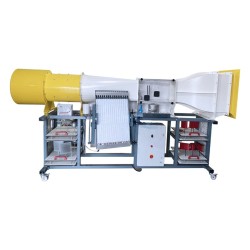
The FM-300 is an open-circuit Eiffel-type wind tunnel designed for aerodynamic and fluid mechanics experiments. It enables accurate investigation of airflow behavior around stationary models.

Product Description

In the FM-300 wind tunnel, ambient air is drawn in and accelerated to create a controlled airflow around a model placed in a transparent measuring section. After passing the model, the air is decelerated in a diffuser and expelled by a high-efficiency axial fan.

The optimized nozzle design and flow straightener ensure a uniform velocity profile with minimal turbulence. Air speeds of up to 28 m/s can be achieved.

Key Features

  • Open-circuit Eiffel-type wind tunnel
  • Transparent closed measuring section
  • Uniform flow with low turbulence
  • Variable-speed, energy-efficient axial fan
  • Digital measurement of lift and drag forces
  • Inclined tube manometer for air velocity display
  • Wide range of accessories for extended experiments

Educational Applications

  • Lift and drag measurement
  • Pressure distribution analysis
  • Boundary layer studies
  • Flow visualization
  • Aerodynamics and fluid mechanics experiments


CBT-100B – Advanced Aircraft Cockpit Instrumentation Trainer


Logo ADF Didactic

Reference : CBT-100B


General Description

The CBT-100B is a fully functional aircraft cockpit simulation system designed for advanced training in aircraft instrumentation, maintenance, and system understanding.

It is ideal for aviation training centers, PART 147 organizations, and technical institutions requiring hands-on cockpit instrumentation training.


Training Applications

  • Aircraft instrument maintenance training
  • Gyroscopic and pitot-static system demonstration
  • Instrument removal and installation training
  • EASA PART 147 ATA-31-00-00 practical tasks

Main Features

  • Complete cockpit simulation (analog + digital)
  • Digital ADAHRS with GPS
  • 3 DOF instrument panel (roll, pitch, yaw)
  • High-resolution touch PFD/MFD display
  • Electronic sensor simulation
  • Fully instrumented engine monitoring system

Smart PFD/MFD Display

Specifications

  • Resolution: 1280 x 800 pixels
  • Brightness: 1200+ nits
  • Capacitive multi-touch screen
  • Dimensions: 7.64” x 5.59” x 3.13”

Functions

  • Flight and engine data display
  • GPS moving map
  • Synthetic vision
  • Split-screen capability
  • Integrated timer
  • Auto brightness control


CBT-100D - Aircraft EFIS/EICAS Cockpit Trainer


Logo ADF Didactic

Reference : CBT-100D

General Description

AIRCRAFT EFIS/EICAS Trainer (CBT-100D) is a complete and fully functional simulation of a typical aircraft cockpit. It includes essential flight, engine, and pitot-static instruments.

This training system provides hands-on maintenance training while also functioning as a demonstration tool for instructors. It demonstrates the principles of gyros, altimeter, and engine instruments, and can also be used for teaching instrument removal and replacement.


Important Notes

If you wish to upgrade this system with navigation systems such as VOR/ILS/VHF, please contact us.

The trainer can be customized with sensors and indicators according to your training needs. Please contact us for special requests.

This trainer also allows performing practical tasks of EASA PART 147 ATA-31-00-00.


Features

  • The system combines primary flight instrumentation, aircraft systems instrumentation, and engine instrumentation.
  • Trainer uses the latest GPS and Digital ADAHRS (Air Data and Attitude Heading and Reference Systems).
  • ADAHRS provides highly accurate and reliable aircraft position, rate, vector, and acceleration data.
  • Three degrees of freedom instrument panel enables full demonstration of attitude and directional gyro functions.
  • Functional engine monitoring system can be connected to engine sensors.
  • Primary flight display mounted on a panel simulating roll, pitch, and yaw controlled by a control yoke.
  • Provision of engine sensor simulation.
  • Pitot-static system for conducting pitot-static checks.
  • Instructor panel for fault insertion.


CBT-100E - Aircraft EFIS Trainer – Complete Avionics Training System


Logo ADF Didactic

Reference : CBT-100E


General Description

The Aircraft EFIS Trainer is a complete and fully functional simulation of a typical aircraft cockpit. It includes essential flight instruments and pitot-static instruments.

This training system provides hands-on maintenance training while also functioning as a demonstration tool for instructors. It demonstrates the principles of gyros, flight instruments, and can be used for teaching display removal and replacement procedures.

NOTE: The system can be upgraded with engine monitoring systems, CBT-100D
NOTE: The trainer can be customized with sensors and indicators according to training requirements.


CBT-100F - Analogue Cockpit Instrumentation System Trainer


Logo ADF Didactic

Reference : CBT-100F


General Description

The CBT-100F is a complete and fully functional analogue cockpit instrumentation training system, designed to replicate a typical aircraft cockpit. It includes essential flight instruments, engine instruments, and a pitot-static system.

This training system provides hands-on maintenance training and serves as a demonstration platform for instructors. It allows understanding of gyroscopic principles, altimeter operation, and engine instrumentation, as well as instrument removal and replacement procedures.


Customization

The trainer can be customized with various sensors and indicators according to specific training requirements.


Training Applications

Practical Training

  • Instrument maintenance training
  • Removal and installation procedures
  • Fault simulation exercises

Compliance Training

Supports practical tasks compliant with EASA PART 147 ATA-31-00-00.


GSC-100A - Aircraft Glass Cockpit Trainer


Logo ADF Didactic

Reference : GSC-100A


Overview

The GSC-100A Aircraft Glass Cockpit Trainer is a fully functional simulation platform replicating a modern aircraft cockpit environment. It integrates essential flight, engine, autopilot, and pitot-static instruments.


Applications

  • Pilot training
  • Avionics technician training
  • Aviation training centers
  • Technical institutes


CPT-110E – Digital Engine Instrumentation System Trainer


Logo ADF Didactic

Reference : CPT-110E - Digital Engine Instrumentation System Trainer


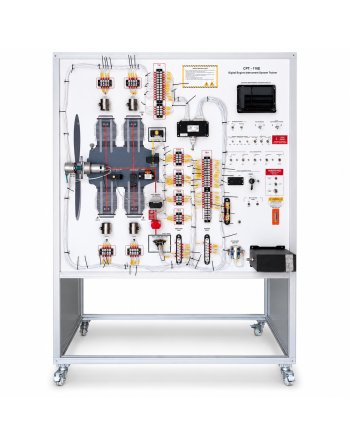
The CPT-110E is a complete and fully operational training system designed for the study of aircraft piston engine instrumentation systems. Developed for technical and educational environments, this trainer enables students and trainees to acquire practical skills in aircraft engine instrumentation, maintenance, troubleshooting, and system analysis.

The system reproduces the operation of real aircraft engine sensors and instruments and provides hands-on training for instrument connection, removal, replacement, monitoring, and fault diagnosis procedures.


Training Applications

The trainer is suitable for aviation training centers, engineering schools, technical institutes, and laboratories specializing in aircraft maintenance and avionics systems.

Example ATA Chapters Covered

  • ATA 31-10-00: Instrument and Control Panels
  • ATA 31-20-00: Independent Instruments
  • ATA 31-26-41: Aural Warning Module Removal & Replacement
  • ATA 31-62-12: EFIS Control Panel Removal & Replacement


Main Features

  • Combination of aircraft instrumentation systems and engine instrumentation systems
  • Functional engine monitoring system connected to real or simulated engine sensors
  • Electronic simulation of engine sensors
  • Instructor panel with fault insertion capability
  • Training video support for instructors and teachers
  • Hands-on maintenance and troubleshooting training


DTA-100 – ARINC 429 & MIL-STD-1553 Training System


Logo ADF Didactic

Reference : DTA-100 - ARINC 429 & MIL-STD-1553 Training System


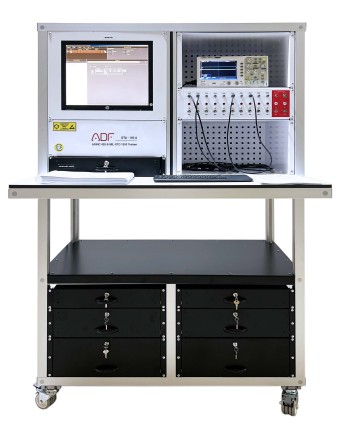
The DTA-100 training system is an advanced educational platform designed for the study of aircraft data communication systems. It enables trainees to understand, analyze, test, and maintain avionics data bus communication used in modern aerospace applications.

This comprehensive training solution integrates two widely used aviation communication protocols: ARINC 429 and MIL-STD-1553. It provides a complete environment for simulation, troubleshooting, diagnostics, and maintenance of avionics communication networks.


ARINC 429 System

ARINC 429 is a digital communication standard widely used in civil avionics systems. It defines the physical, electrical, and functional characteristics of data exchange between onboard aircraft equipment.

Using the DTA-100 trainer, trainees can study data frame structures, transmission methods, and communication processes between avionics devices operating with the ARINC 429 protocol.


MIL-STD-1553 System

MIL-STD-1553 is a military-grade data bus communication standard used in aerospace and defense applications. It enables communication between multiple avionics systems while complying with military mechanical, electrical, and functional requirements.

The training system allows users to analyze MIL-STD-1553 bus operation, monitor data exchange processes, and perform diagnostic and maintenance procedures.