

References
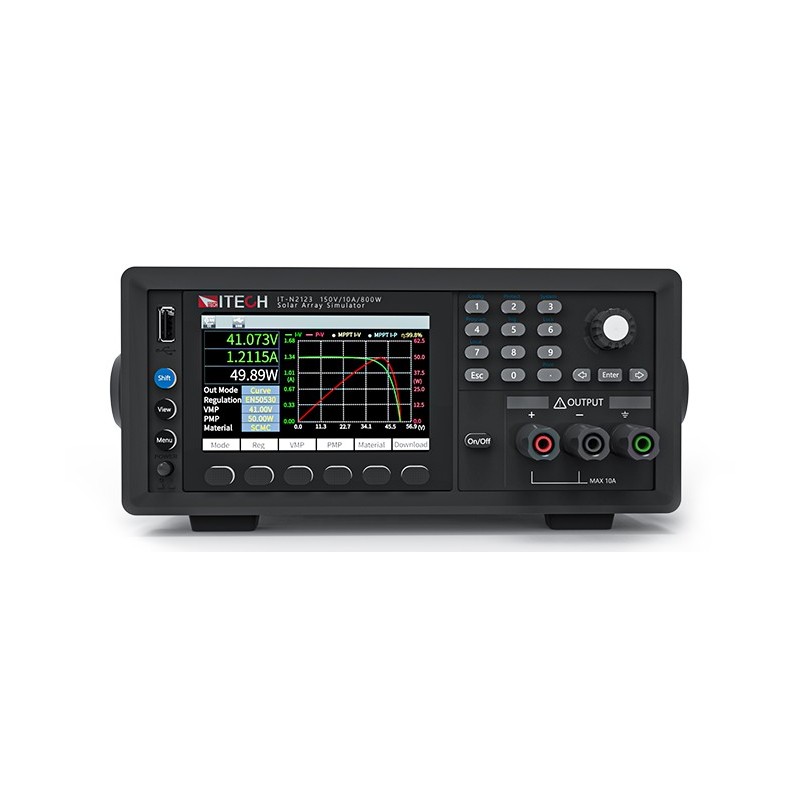
IT-N2121 Solar array simulator 80 V, 25 A, 800 W
IT-N2131 Solar array simulator 80 V, 25 A, 1500 W
IT-N2123 Solar array simulator 150 V, 10 A, 800 W
IT-N2133 Solar array simulator 150 V, 10 A, 1500 W
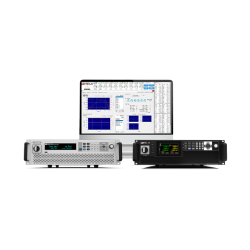
The IT-N2100 Series Solar Array Simulator is a high-performance DC power supply designed to accurately replicate real-world photovoltaic (PV) array behavior. With ultra-fast I–V curve response and advanced simulation capabilities, it enables precise testing of solar microinverters, power optimizers, and PV power systems under dynamic environmental conditions.
The system faithfully reproduces solar panel characteristics across varying temperature, irradiance, shading, and aging scenarios. Its high-voltage architecture, ultra-low ripple performance, and rapid MPPT response make it an ideal solution for R&D, validation, and production testing environments.
The IT-N2100 provides a reliable, flexible, and standards-compliant solution for advanced photovoltaic system validation.


The IT-N2100 Series delivers exceptional dynamic performance with a 500 kHz current loop speed and support for MPPT tracking frequencies up to 250 Hz.
With up to 4096 programmable I–V curve points, the simulator precisely replicates real photovoltaic array behavior. Even under high-speed MPPT conditions, the output strictly follows the preset I–V curve, ensuring maximum test reliability and repeatability.
This high-response architecture guarantees accurate validation of micro-inverters and power optimizers operating under demanding dynamic conditions.

Accurate MPPT evaluation requires a clean and stable source signal. The IT-N2100 Series features ultra-low current ripple and minimal high-frequency noise, preventing interference with inverter current sampling and MPPT algorithms.
The result is enhanced measurement precision and greater confidence in performance validation.

The IT-N2100 integrates five versatile PV operating modes to meet diverse testing requirements:
The intuitive graphical interface provides real-time MPPT monitoring of devices under test, including micro-inverters and power optimizers.
Model files can be imported via USB, and multi-channel systems can be centrally managed using dedicated PV control software—providing a flexible and scalable solution for advanced PV system validation.


References
SAS1000 Solar array software for IT6500C/IT6000B/IT6000C/IT-M3600
SAS1000L Solar array software for IT6500C/IT6000B/IT6000C/IT-M3600 (power ≤15kW)
SAS1000M Solar array software for IT6500C/IT6000B/IT6000C/IT-M3600 (multi-channel)
ITECH introduces its latest high-speed, high-performance photovoltaic simulation solution. When combined with high-power DC power supplies, the SAS1000/L solar array simulation software accurately reproduces solar array I-V curves, with output voltage up to 2250 V and scalable system power up to 10 MW.
The system delivers fast dynamic response, excellent control accuracy, high repeatability, outstanding stability, and precision performance. It features built-in simulation models compliant with EN 50530, Sandia National Laboratories PV model, NB/T 32004, CGC/GF004, and CGC/GF035.
Users can easily configure test regulations, material types, Vmp, Pmp, and other parameters to simulate I-V curve characteristics and automatically generate test reports. The software is ideal for static and dynamic maximum power point tracking (MPPT) performance testing of photovoltaic inverters.
References
IT-N2121 Solar array simulator 80 V, 25 A, 800 W
IT-N2131 Solar array simulator 80 V, 25 A, 1500 W
IT-N2123 Solar array simulator 150 V, 10 A, 800 W
IT-N2133 Solar array simulator 150 V, 10 A, 1500 W
The IT-N2100 Series Solar Array Simulator is a high-performance DC power supply designed to accurately replicate real-world photovoltaic (PV) array behavior. With ultra-fast I–V curve response and advanced simulation capabilities, it enables precise testing of solar microinverters, power optimizers, and PV power systems under dynamic environmental conditions.
The system faithfully reproduces solar panel characteristics across varying temperature, irradiance, shading, and aging scenarios. Its high-voltage architecture, ultra-low ripple performance, and rapid MPPT response make it an ideal solution for R&D, validation, and production testing environments.
The IT-N2100 provides a reliable, flexible, and standards-compliant solution for advanced photovoltaic system validation.