
- New

Reference : 09057-99
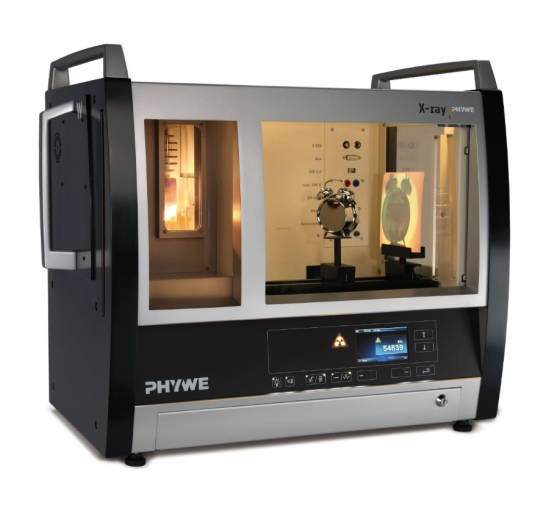
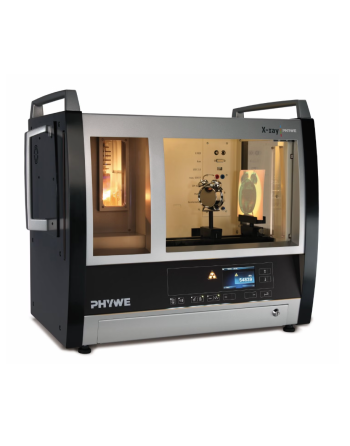
The XR 4.0 expert unit is a microprocessor-controlled X-ray system designed for science education, universities, vocational training centres, and scientific laboratories. Compatible with interchangeable X-ray tubes featuring iron, copper, molybdenum, and tungsten anodes, it supports a comprehensive range of practical experiments in X-ray physics, crystallography, material analysis, X-ray fluorescence, dosimetry, and computed tomography.
The integrated 4.3-inch TFT colour display, USB 2.0 computer control, independent safety monitoring circuits, and LED chamber illumination facilitate experimental operation and observation.
Important: At least one compatible X-ray tube, sold separately, is required to operate the unit.
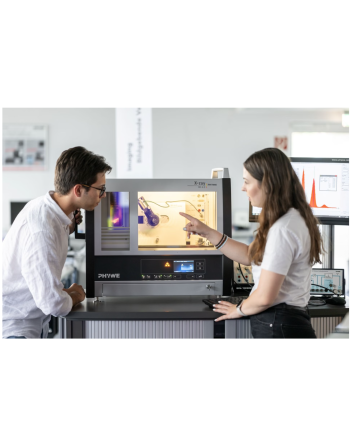
The XR 4.0 expert unit is a microprocessor-controlled educational X-ray system featuring quick-change X-ray tube technology. It is designed for secondary and higher education institutions, vocational training centres, and scientific laboratories requiring a versatile platform for practical investigations in X-ray physics.
Its fully shielded enclosure is designed for educational experiments involving X-rays. The system incorporates independent circuits for monitoring door position and locking. All operations must comply with applicable local radiation protection regulations. Any claim of formal compliance with the requirements of the German Federal Office for Radiation Protection (Bundesamt für Strahlenschutz, BfS) should be verified against the manufacturer's documentation.
The interchangeable tube technology supports experiments using different anode materials: iron (Fe), copper (Cu), molybdenum (Mo), and tungsten (W). Adjustable high voltage and emission current allow operating conditions to be adapted to experimental objectives. The system can be operated directly through its integrated display or controlled from a computer via USB 2.0.
Control and Display System
Safety System
Operating Parameters
Dimensions and Electrical Requirements
At least one compatible X-ray tube, sold separately, is required to operate the XR 4.0 expert unit.
The following upgrade sets extend the experimental capabilities of the XR 4.0 unit and cover additional topics in physics and material analysis.
| Article No. | Description |
|---|---|
| 09125-88 | XR 4.0 X-Ray Solid State Physics Upgrade Set |
| 09135-88 | XRC 4.0 X-Ray Characteristics Upgrade Set |
| 09145-88 | XR 4.0 X-Ray Structural Analysis Upgrade Set |
| 09155-88 | XR 4.0 X-Ray Imaging Upgrade Set |
| 09165-88 | XR 4.0 X-Ray Material Upgrade Set |
| 09175-88 | XR 4.0 X-Ray Dosimetry Upgrade Set |
| 09185-88 | XR 4.0 X-Ray Computed Tomography Upgrade Set |
| 09057-10 | XR 4.0 X-Ray Goniometer |
The XR 4.0 unit supports an extensive programme of practical experiments, subject to the availability of the required X-ray tubes, detectors, accessories, and upgrade sets. The following experiments are grouped by subject area to facilitate the selection of activities according to the intended learning objectives.
A. X-rays: Fundamental Principles and Applications
| Article No. | Experiment Titles |
|---|---|
| P2540015 | Counter tube characteristics |
| P2540025 | Radiographic examination of objects |
| P2540035 | Qualitative examination of X-ray absorption |
| P2540045 | Ionizing effect of X-radiation |
| P2540105 | Characteristic X-rays of copper |
| P2540205 | Characteristic X-rays of molybdenum |
| P2540305 | Characteristic X-rays of iron |
| P2540405 | Influence of anode current and anode voltage on the intensity of characteristic X-rays |
| P2540505 | Monochromatisation of molybdenum X-rays |
| P2540605 | Monochromatisation of copper X-rays |
| P2540705 | Splitting of the molybdenum Kα doublet and investigation of its fine structure |
| P2540805 | Splitting of the iron Kα doublet and investigation of its fine structure |
| P2540905 | Duane-Hunt displacement law and determination of Planck’s constant |
| P2541005 | Characteristic lines of different anode materials and Moseley’s law |
| P2541105 | Absorption of X-rays |
| P2541205 | K and L absorption edges: Moseley’s law and the Rydberg relation |
| P2541705 | Compton scattering |
| P2541805 | X-ray dosimetry |
B. Crystallography and X-Ray Diffraction
| Article No. | Experiment Titles |
|---|---|
| P2541305 | Orientation of NaCl single crystals |
| P2541405 | Cubic crystal structures: Debye-Scherrer powder method |
| P2541505 | Hexagonal crystal structures: Debye-Scherrer powder method |
| P2541605 | Investigation of crystal structures using the Laue method |
| P2541606 | Laue method using the XRIS digital X-ray image sensor |
| P2542105 | Debye-Scherrer patterns of powders with three cubic Bravais lattices using Bragg-Brentano geometry |
| P2542205 | Powder diffraction analysis of diamond-type crystal structures |
| P2542305 | Powder diffraction analysis of hexagonal structures |
| P2542405 | Powder diffraction analysis of tetragonal structures |
| P2542505 | Powder diffraction analysis of cubic structures |
| P2542605 | Investigation of the intensity of Debye-Scherrer reflections using a cubic crystalline powder |
| P2542705 | Investigation of the texture of rolled sheets using the Debye-Scherrer X-ray diffraction method |
| P2546205 | Determination of the lattice constants of a single crystal |
C. X-Ray Fluorescence Analysis and Energy Spectroscopy
| Article No. | Experiment Titles |
|---|---|
| P2542805 | Characteristic X-rays of tungsten |
| P2544005 | X-ray energy spectroscopy and detector calibration |
| P2544105 | Detector energy resolution |
| P2544205 | Intrinsic fluorescence radiation of the detector |
| P2544505 | Qualitative X-ray fluorescence analysis of metals and Moseley’s law |
| P2544605 | Qualitative X-ray fluorescence analysis of alloyed materials |
| P2544705 | Qualitative X-ray fluorescence analysis of powder samples |
| P2544805 | Qualitative X-ray fluorescence analysis of solutions |
| P2544905 | Qualitative X-ray fluorescence analysis of ore samples |
| P2545005 | Quantitative X-ray fluorescence analysis of alloyed materials |
| P2545105 | Quantitative X-ray fluorescence analysis of solutions |
| P2545205 | Measurement of layer thickness using X-ray fluorescence |
| P2546005 | Investigation of the Compton effect by direct energy measurement |
| P2546105 | Investigation of K and L absorption edges using energy-dispersive spectroscopy |
| P2546305 | Verification of the Duane-Hunt law |
D. X-Ray Imaging, Computed Tomography and Applications
| Article No. | Experiment Titles |
|---|---|
| P2541905 | Investigation of a contrast agent using a blood vessel model |
| P2542005 | Determination of the length and position of an invisible object |
| P2550105 | Computed tomography |
| P2550106 | Principles of digital X-ray imaging |
| P2550205 | Principles of X-ray attenuation and contrast |
| P2550305 | Principles of beam intensity |
| P2550405 | Principles of resolution and detail detectability |
| P2550505 | Principles of computed tomography scanning |
| P2550605 | Camera alignment |
| P2550705 | Optimization of computed tomography image quality |
| P2550805 | Beam hardening and metal artefacts |
| P2550905 | Hounsfield units |

Reference : 09057-99
The XR 4.0 expert unit is a microprocessor-controlled X-ray system designed for science education, universities, vocational training centres, and scientific laboratories. Compatible with interchangeable X-ray tubes featuring iron, copper, molybdenum, and tungsten anodes, it supports a comprehensive range of practical experiments in X-ray physics, crystallography, material analysis, X-ray fluorescence, dosimetry, and computed tomography.
The integrated 4.3-inch TFT colour display, USB 2.0 computer control, independent safety monitoring circuits, and LED chamber illumination facilitate experimental operation and observation.
Important: At least one compatible X-ray tube, sold separately, is required to operate the unit.