
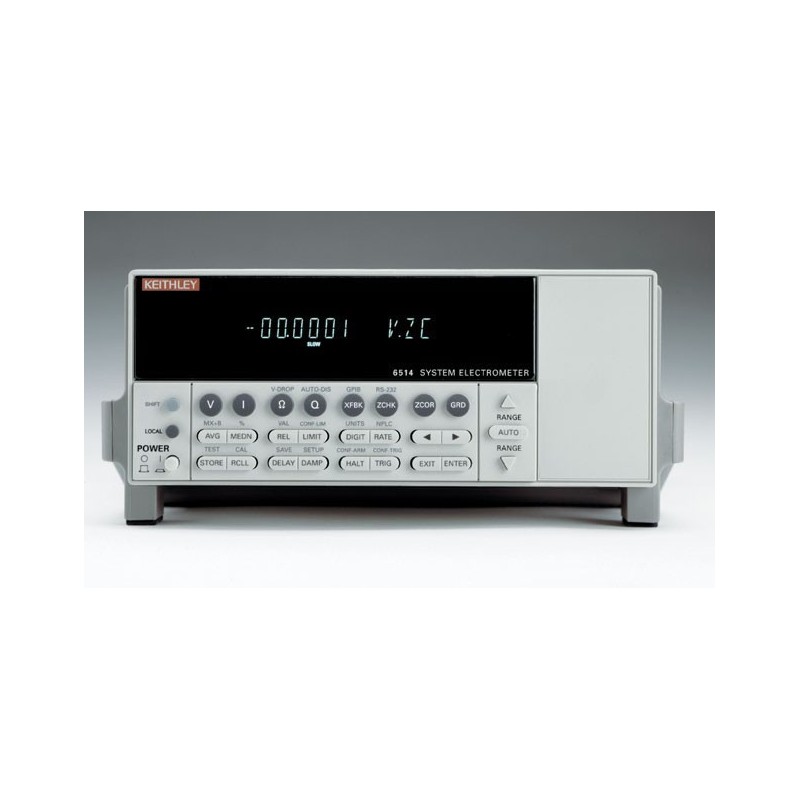


Reference : 6514
The Keithley 6514 Electrometer delivers industry-leading performance for low-level measurement applications:
Designed for precision, speed, and integration flexibility, the Model 6514 is ideally suited for demanding research, development, and production test environments.
The Keithley 6514 Electrometer combines flexible interfacing capabilities with exceptional current sensitivity, charge measurement performance, resolution, and speed—matching or exceeding earlier electrometer models.
Equipped with built-in IEEE-488, RS-232, and digital I/O interfaces, the Model 6514 simplifies the integration of fully automated, high-speed test systems for low-level measurements.
This 5½-digit instrument is specifically engineered for applications requiring fast and precise measurements of low currents, voltages from high-resistance sources, charge, and high resistance.
Delivering outstanding measurement performance at a highly competitive price point, the Model 6514 offers significantly greater current sensitivity and a substantially lower voltage burden—down to 20 μV—than most high-end digital multimeters (DMMs). While priced comparably to many premium DMMs, it provides superior performance for low-level measurement applications.
The Model 6514 provides the sensitivity, flexibility, and speed required for a broad range of research and development applications. Compared to legacy electrometer designs, it delivers more accurate data in less time.
Typical applications include:
Widely used by researchers in physics, optics, and materials science, the Model 6514 also represents a cost-effective alternative to high-end DMMs for precision low-current measurement tasks.
Building on the proven performance of earlier Keithley electrometers, the Model 6514 incorporates a built-in constant current source that simplifies resistance measurements and enhances overall test efficiency.
When measuring dark current (see Figure 1) from devices such as a photodiode, the ammeter detects the sum of two distinct currents.
The first is the dark current (ID), generated by the detector in the absence of incident light — the signal of interest.
The second is the leakage current (IL), produced by the voltage burden (VBURDEN) present at the ammeter’s input terminals.
In a feedback ammeter configuration, the primary source of voltage burden is the amplifier’s offset voltage. This generates an error current defined as:
IL = VBURDEN / RL
Without offset cancellation techniques, this leakage current directly impacts measurement accuracy.
Figure 2 illustrates how the Keithley 6514 Electrometer uses its CAL VOFFSET function to reduce VBURDEN to within only a few microvolts — effectively at the level of the instrument’s voltage noise. As a result, the measured current corresponds exclusively to the true dark current (ID) of the photodiode.
In the same manner, offset currents can also be compensated. Earlier-generation electrometers relied on internal numerical correction techniques; however, the voltage burden remained physically present, meaning the measured dark current still included the error term IL = VBURDEN / RL.


Electrometers enable current measurements with significantly lower terminal voltage than is achievable using digital multimeters (DMMs).
As illustrated in Figure 3, DMMs measure current through a shunt resistor that develops a voltage across the input circuit — typically up to 200 mV at full scale. This creates a voltage burden of approximately 200 mV, which can reduce the measured current and introduce substantial measurement error, particularly in low-level applications.
Electrometers minimize this effect by using a feedback ammeter configuration (Figure 1). The Model 6514 further reduces terminal voltage to near the instrument’s voltage noise floor by actively canceling the remaining offset voltage (Figure 2).
Any residual error signals are negligible compared to the measurement errors commonly encountered when using a DMM for low-current measurements.

Reference : 6514
The Keithley 6514 Electrometer delivers industry-leading performance for low-level measurement applications:
Designed for precision, speed, and integration flexibility, the Model 6514 is ideally suited for demanding research, development, and production test environments.